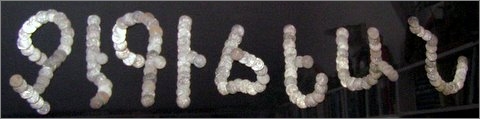





This says Chekijian in Armenian

Images          Narrative          Contacts    
The Name            

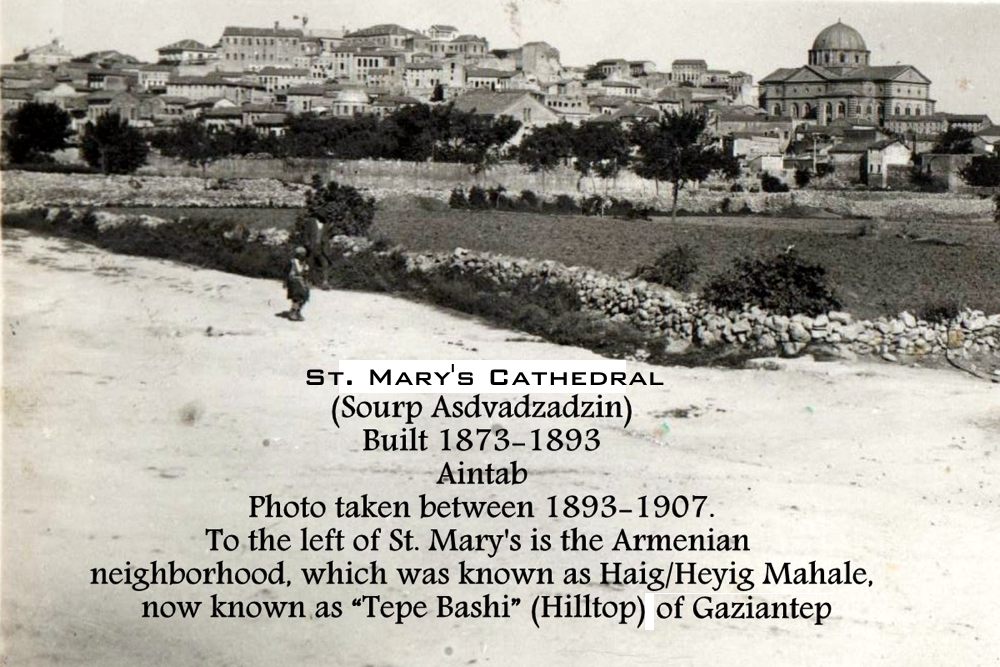
According to my research, Aintab was a regional market town well over 3000 years ago, perched at an elevation of 3,100 feet on the Taurus (or Toros) mountain chain. The Hittites called it Andiabe [“Ain” and “Dayib” together mean “tasty water spring”], and the Crusaders called it Hantab. It lies on the eastern fringes of the Armenian kingdom of Cilicia, and 85 miles (130 kilometers) north of the ancient fortress city of Aleppo, Syria - a metropolis which has a recorded history dating back 5,000 years. By the way, Aintab is now known as Gaziantep, Turkey. Its location on the Silk Road connected it to trade routes through India, Persia, the Middle East, Jerusalem, Egypt and Europe.

The Chekijian family would have never ended up in Aintab, were it not for Nubar Pasha Nubarian (1825-1888) of Cairo, Egypt who was a well traveled industrialist in Egypt and was most familiar with the Armenian artisans and merchants within the Ottoman Empire. Nubarian had an uncle whose name was Boghos Bey Yusufian  (1768-1844). Yusufian was the Secretary to the Egyptian Wali (governor), Mohamed Ali – he was the Wali’s Chief Dragon Master (a title akin to “chief of staff”) and his most trusted advisor on judicial, economic and military matters. Yusufian masterminded the Wali’s takeover of Ottoman lands within 100 miles of Constantinople in the early 1830’s – and the Wali’s military command had taken over vast territories from the Ottomans. From 1831 to 1840,  Wali Mohamed Ali had based his command centre in Aintab.  Well, in order to service the need for supplies of his military commanders, Wali had relocated approximately 30,000 Armenian artisans and their families from regional commercial centers to Adana (Mercin & Ceyhan, nearby seaports in present-day Turkey that had access to the Mediterranean and to supplies in Egypt) and to Aintab, which served as a garrison.

THEN A CHEKIJIAN ENTERS THE PICTURE

One of the relocated Armenian craftsmen was Hagop Chekijian, son of Krikor Chekijian (born 1790's). Hagop was forced out of Caeserea (now Kayseri in central Turkey, an ancient Roman town about 100 miles northwest of Aintab), and  he relocated to Aintab with several thousand Armenian families. Hagop had ten sons (!) at the time, and they went with him. By the mid-1830s, they had settled in Aintab, where Hagop became a tailor and opened a workshop. He was successful, as shown in the fact that his excellent craftsmanship was cited in the book A Briefer History of Aintab (Union of the Armenians of Aintab, 1957). One of Hagop’s sons was named Kevork, who was the youngest. He too was born in Caesarea, according to the referenced book. Over time, all of his nine brothers must have left Caesarea - or even may have perished due to the 1870s cholera epidemic that swept the area. One of Kevork’s brothers may have settled in Marash (a suburb of Aintab), and one or two may have moved as far north as Ankara and  Istanbul. One brother's name was Hrant. According to Census records in the 1860's, he came to the U.S. and became a doctor in Chicago before relocating to California by the 1870's. There, Hrant changed his last name to Emerson, according to A Briefer History of Aintab.

Of the ten brothers, only Kevork remained in Aintab by the end of the 19th century, and he apprenticed at a young age at his father’s tailor shop. In the late 1850’s, Kevork took over the business. He married Meroum Kazanjian (whose brother Sarkis was a cooper, his grand-daughter Siran Kazanjian, married Kevork’s grandson Hagop Chekijian in 1945). Pictured below are the four sons of Kevork Chekijian (B.Caesarea 1840, D.Aintab 1905):

Brothers

Hagop, Manuel, Nazaret and Hovannes. 

They produced over 2,000 descendents over the next seven generations.

Before that, though, they learned how to be tailors from their father in Aintab. The brothers were successful there, and they did not adopt the European styles and fashions of the time. They created custom-made military officer uniforms, and this was one of the key reasons why the Chekijian brothers survived the Armenian Genocide of 1915. But their trade essentially became obsolete after World War I because the Ottoman Empire fell and European-style suits became the norm.  All four brothers survived the Genocide. They died of natural causes in the 1920's and 30's, Hovhaness in Aintab, and Manuel, Nazaret, and Hagop, in Aleppo.

FAST FORWARD

A recent genealogical DNA test of a living Chekijian male indicates that the family’s genes had originated 50,000 years ago in Ethiopia, migrating to the Fertile Crescent and up to Rome. The results also show that the DNA of 20% of the population of southern Spain and Southern Italy and 40% of the population of Scotland and Britain have the exact same genealogic origins.

dna


THE FIRST KNOWN CHEKIJIAN IN THE UNITED STATES OF AMERICA


HRAND KRIKOR CHEKIJIAN (a.k.a.) Dr. Henry K. Emerson 
Born 1864 (Aintab, Turkey),  Died 1941 (Los Angeles, CA)  
  
Son of Krikor Chekijian (1830-1895) who had nine brothers and one sister (Araxi). They were all born in Caesarea and moved elsewhere by 1850. Several of them settled in Aintab, such as the eldest, Krikor, and Kevork. There, they became prominent tailors with their father, Hagop.

Krikor had three sons: Hagop, Hrand and Gurgen.

We'd like to know the significance of the pin on his lapel in the above image.

Hrand was the first cousin of Hagop Chekijian (the head of the household in the family photo taken in Aintab seen HERE). 

Hagop was Krikor’s brother Kevork’s oldest son, the other three sons of Kevork being Manuel, Nazaret and Hovannes Chekijian - all were born in Aintab).  

Apparently in the 1880's when Krikor’s second son Hrand was in his early 20's, he emigrated to the U.S. through Ellis Island via Alexandria, Egypt (where there were other Chekijians at the time) and adopted the name Henry K. Emerson. This was his name when he graduated from Cleveland College of Physics and Surgery in Cleveland, Ohio on March 17th, 1897. His specialization was osteopathy.  
 
After a brief period of practicing medicine in the state of Missouri and becoming certified there in 1895, he relocated to Los Angeles and married Lura Brown. Lura was born in 1880 in Hiawatha, Kansas and also was an M.D., with a degree from the University of Southern California in anesthesiology.  
 
"Dr. H. K. Emerson" had a son in 1916 who was named Henry (Hank) Krikor Emerson. They lived on 7th Street in downtown Los Angeles. There, Dr. H.K. Emerson had a clinic, and he saw patients six days a week.  
 
One story goes that a patient of Henry's was an "ice-cream man" who used to bring a cold treat to the doctor in lieu of payment.  
 
Henry was also involved in industrial medicine and he received a badge as a surgeon for the Los Angeles Fire Department. Apparently Dr. Emerson used to attend many Armenian picnics in the San Fernando Valley when it largely consisted of fruit tree orchards.  
 
He died at the age of 77.  

HENRY (HANK) KREKOR EMERSON (1916-1944) 
 
Dr. H. K. Emerson's only child was born and raised in Los Angeles and graduated from UCLA and Harvard Business School. He was a Captain in the U.S. Army (that’s his captain’s uniform in the above image) on the staff of Major General Charles H. Corlett (1889-1971). Corlett was nicknamed "Cowboy Pete". He commanded troops in both the Pacific and European theaters during World War II, led the attack on Kiska in 1943 and commanded the 7th Infantry Division in the amphibious assault and the taking of Kwajalein in the Marshall Islands between January 31 to February 7,1944.   
 
Hank married Dorothy Mae Wasson, and their son Henry Gregory Emerson was born on April 19th 1942.  
 
Less than two years later on February 4, 1944 Hank was killed on Kwajalein while engaged in forward reconnaissance for which he had volunteered. Hanks citation for the Distinguished Service Cross awarded on March 4, 1945 (America’s highest award after the Congressional Medal of Honor) notes that he led his tank out ahead of infantry troops and against enemy resistance and his forward tank position provided both cover and inspiration to the ground troops behind him. When he exited his tank at the North end of the Island to reconnoiter on foot he was instantly killed by enemy fire. 

Dorothy remarried Barry Stubbs, who adopted Dorothy’s only son, Henry Gregory Emerson. They renamed him Gregory Emerson Stubbs. When he grew up, Gregory founded a law firm in the San Francisco bay area, and he now lives in Sonoma, California and has four daughters. 

Through a random DNA test, Gregory Emerson Stubbs’ relation has been verified as an “exact match” with Cesar Chekijian, who is the great-great-grandson of Gregory’s great-great-grandfather Krikor’s younger brother Kevork.

HAGOP CHEKIJIAN (1862-1935) 

Hagop is the older brother of Hrand (Dr. H. K. Emerson), also born in Aintab, who immigrated to Montevideo, Uruguay in the 1930’s with his two sons Aram and Nazaret and had two more sons, Garabed and Mardiros. They were born in Montevideo (each of the four sons had four children, whose grandchildren and great-grandchildren now live in Uruguay).
 

GURGEN CHEKIJIAN (1868-1940) 

Gurgen was the youngest brother of Hrand (Dr. H. K. Emerson) and was also born in Aintab. According to published records, he came to the U.S. in the early 1900’s and was issued a Social Security number in California.  We don’t know about his descendants of his as yet.


FINALLY, MISCELLANEOUS HISTORICAL NOTES

[a] 
Kayseri
(Caesarea to the ancient Romans) is a town about 100 miles northwest of Aintab, in central Asia Minor. It is the place where two apostles of Jesus Christ (Mathew and Bartholomew) were beheaded. They are said to be buried at the Sourp Garabed Cathedral in Kayseri. Kayseri is on a plain at the foot of Mt. Erjias guarded by two perimeter walls, an outer and inner. The outer wall was built in the 11th-12th centuries. 

The original Roman Caesarea is just northwest of the current city. Within the walls, there were two Armenian churches St. Astvatsatsin and St. Sarkis. They were located in places that are dug underground into the hillsides like most of the living quarters in Capadocia. These are dark places where people descended into by wooden ladder. Until the 18th century, there were 500 Armenian families living within the walls. Some were wealthy merchants and teachers, but most were tailors and cabinet makers according to the chronicles of Simeon of Poland. He visited Kayseri around 1615 AD. Simeon said that Armenians who lived within the walls of Kayseri only spoke Turkish or Persian, and that other Armenians living outside the walls spoke Armenian. This explains why most Armenians from Aintab spoke Turkish - yet they used the Armenian alphabet to write in Turkish.

Well the Chekijians must have been one of the 500 Armenian families living within the inner walls of Caesarea.

The outer walls of Caesarea were built in the 11th century, so it more than likely was built by the Crusaders as an added defensive measure. Besides, in light of the fact that Chekijian DNA has migrated to a significant extent to Scotland and Britain, it is likely that Scottish and British Crusaders intermarried with local Armenians during the 11th-13th centuries – and that their families eventually traveled back to settle in Britain and Scotland. The 20% of the current population of southern Italy that contains the same Chekijian DNA would more than likely have roots in the Roman period. That is the period when Armenia and Rome co-existed (Armenians and Romans never battled against each other directly), and several Roman legions heading to the Middle East and North Africa had major encampments in Capadocia. Romans founded Caesarea, and being that Capadocia was part of the Greater Armenia at the time, Caesarea would have been populated in most part by Armenians who would have in turn intermarried with the Romans. Some of their progeny would have returned to Rome.

[b]
HISTORY OF CAESAREA/CAPPADOCIA

NEW 3 Jun 2009: Watch THIS PowerPoint presentation about an amazing discovery in the region.

The province known as Cappadocia in south central Asia Minor was rich in history, being the original home of the pre-historic Hittite people. It was an inland territory, bordering several eastern provinces such as Armenia in the east, Mesopotamia, Cilicia and Syria to the south, Galatia to the west and Pontus to the north, a territory with a 250 mile radius (450 km) which was centered around the fortified city of Mazaca.

Mazaca was the ancient Hittite capital from before 2,500 B.C. It later became the residence of the Cappadocian kings. The city was renamed Caesarea in 10 B.C. by Archelaus, king of Cappadocia (Hellenic Kappadokía, which in turn is from Old Persian: Katpatuka meaning "the land of beautiful horses”).

After the fall of the Hittite empire around 1750 BC, Cappadocia was ruled by various invading factions, such as the Phyrgians, Cimmerians and then the Armenians starting in 1000 B.C.

Then the Persians came to power in the mid 6th century BC and ruled for over 200 years, establishing a more permanent government system and entrusting it mostly to local nobles. The Persians also allowed the Cappadocians more freedom in cultural practice, allowing them to worship their fire god and consider the volcanoes of the region as sacred.

It was the Persian word Katpatuka or "land of the well bred horses" that eventually came to identify the region, but they allowed the locals to practice their own languages freely. The enmity between the Macedonian king Alexander the Great and the Persian King Darius would eventually unravel eastern control of the territory, as Alexander spread Hellenistic control. Alexander never visited Cappadocia in any official capacity, satisfied with tributary allegiance and free to continue his eastern march.

After the death of Alexander in 323 BC, administration of Cappadocia fell back again to the Armenians with the dynasty of King Ariarathes. His family line would rule the kingdom until 93 BC, and were responsible for the establishment of positive relations with Rome. Under Ariarathes IV, Cappadocia supported Rome in the early 2nd century BC against Perseus of Macedonia, son of Philip V. Having won the faith of the growing power of Rome, the Cappadocians remained on favorable terms with independent status for the next two centuries becoming part of Greater Armenia through the reign of the Armenian King Dikran The Great, who during 66 B.C. aided Rome against the Seleucids of Syria and later took part in a great defeat against Aristonicus of Pergamum. Instability in the region, and the rise of Mithridates of Pontus, brought war to the entire Asian world, and the Cappadocians fought valiantly in defense of their own independence. Pompey's final victory established new independence for Cappadocia in 63 BC under a new dynastic King, started by Ariobarzanes.

In the civil wars that ended the Roman Republic, the Cappadocians played a dangerous game with the powers that were in Rome. At first, they understandably supported their benefactor Pompey against Caesar. After his victory at Pharsalus, they switched sides in support of Caesar and maintained their own autonomy. In the civil war that erupted between Caesar's assassins, Antony and Octavian, they first supported Brutus and Cassius who held firm control of the eastern provinces. After their defeat, their allegiance went over to Antony and finally to Octavian after he came to dominant the entire Roman world. Cappadocia maintained independence as a client state until 17 AD, when the Emperor Tiberius formally incorporated it into an official province of the Empire.

During the course of the Roman Imperial period, Cappadocia maintained itself as a largely peaceful and uneventful place on the interior, but also served as an important border with eastern enemies. Under Vespasian and continuing well into the Byzantine years, Legio XII Fulminata was garrisoned at Melitene, which became an early bastion of Christianity. Legio XV Apollinaris was stationed at Satala along the border with Armenia and Legio XVI Flamia Firma guarded Samosata on the border with Mesopotamia and the Euphrates River.